
Mulgrave Mill
| Mulgrave Mill | |
|---|---|
|
| |
| Location | |
| Coordinates | 17.09183° S, 145.78959° E |
| State | Queensland |
| Region | Northern Region |
| LGA | Cairns Regional Council |
| Details | |
| Established | 1896 (130 years ago) |
| Owner | MSF Sugar |
| Gauge | 610 mm (2 ft) |
| Annual Crush | 968,391 tonnes (2024 throughput) |

Mulgrave Sugar Mill (also known as Mulgrave Central Mill) is a sugar mill located in Gordonvale, approximately 20 kilometres south of Cairns, Queensland. The mill commenced crushing in 1896 and for most of its independent history was operated by the grower-owned Mulgrave Central Mill Company Limited. It is now owned by MSF Sugar, a subsidiary of the Thai-based Mitr Phol Group.
The mill has remained an important processing centre for the Cairns sugar district and subsequently absorbed cane supply and railway infrastructure following the closure of neighbouring Hambledon Mill in 1991 and Babinda Mill in 2011.
History
Establishment
The establishment of Mulgrave Central Mill followed the passage of the Sugar Works Guarantee Act 1893. The original company comprised 44 local farmers who mortgaged their properties to secure a £44,000 Queensland Government advance for construction of the mill and its tramways.[1]
The memorandum of association of the Mulgrave Central Mill Company Limited was drawn up in 1893 and the company was registered in Brisbane in 1895. Pioneer settler Richard Blackwell was among the early directors and reportedly provided part of his land for the mill site.
Construction was undertaken by A. & W. Smith and Company of Glasgow in 1896 under a contract valued at £26,850. The mill's first crushing season ran from October 1896 until March 1897. During that season, 13,000 tons of cane were processed to produce 1,351 tons of sugar.[1]
Early transport
The mill's 610 mm (2 ft) gauge cane tramway system developed separately from the public tramway connecting Gordonvale with Cairns.
The Cairns Divisional Board constructed a 1,067 mm (3 ft 6 in) gauge tramway south from Cairns after the proposed Mulgrave mill created demand for a reliable transport route to the port. The first section reached Mulgrave Mill in 1897 and carried sugar and other agricultural produce as well as passengers.[2]
Parts of the public tramway incorporated mixed-gauge track, allowing the mill's 610 mm gauge locomotives to use sections of the route for local cane and firewood traffic.
In 1911, the Queensland Government purchased the Cairns–Mulgrave Tramway from Cairns Shire Council and incorporated it into the developing state railway system and North Coast railway. This 1,067 mm gauge public railway remained distinct from Mulgrave Mill's own 610 mm cane railway network.[3]
Operational history
Mulgrave developed into one of the most successful central mills established under the Sugar Works Guarantee legislation. Its cane railway network expanded progressively through the surrounding districts as cultivation increased.
During the Second World War, Gordonvale became a major military centre. Approximately 3,000 American paratroopers were stationed and trained in the district before deployment to New Guinea. The wartime presence had a substantial effect on the town in which the mill remained the dominant industrial enterprise.
A major change occurred following the closure of Hambledon Mill at Edmonton in 1991. The Central Sugar Cane Prices Board approved the transfer of all Hambledon assignment holders to Mulgrave, together with arrangements intended to preserve the former Hambledon cane transport system.[4]
Mulgrave crushed 592,435 tonnes of cane in 1991. In 1992, the first full season after taking over the former Hambledon supply area, throughput increased to 1,327,981 tonnes.[5] The additional cane required changes to factory operation and transport arrangements and substantially enlarged Mulgrave's supply area.
Ownership
Mulgrave Central Mill remained grower-owned for more than a century.
In 2008, the Maryborough Sugar Factory Limited acquired the Mulgrave Central Mill Company. By the close of its takeover offer in July, Maryborough Sugar had received acceptances representing 98.52 per cent of Mulgrave's A-class shares, with the remaining shares subsequently subject to compulsory acquisition.[6]
In 2010, Maryborough Sugar Factory and Bundaberg Sugar agreed to combine their Far North Queensland milling interests in the Northern Milling Joint Venture. The venture commenced on 1 January 2011 and comprised Mulgrave Mill together with Bundaberg Sugar's Babinda Mill, Tableland Mill and South Johnstone Mill.[7]
Babinda Mill ceased operations in February 2011 because of insufficient cane supply and excess milling capacity in the region. Cane previously processed at Babinda was redistributed between Mulgrave and South Johnstone, with associated investment in the mills and cane railway system to allow cane to be moved between the former mill areas.[8]
MSF subsequently exercised its option to acquire Bundaberg Sugar's remaining interest in the Northern Milling Joint Venture, giving it full ownership of the Tableland, South Johnstone and former Babinda milling assets.
In February 2012, Thai sugar producer Mitr Phol completed its takeover of MSF Sugar. Mulgrave has since remained an MSF Sugar mill under Mitr Phol ownership.[9]
Infrastructure
Tramway
Mulgrave Mill operates an extensive 610 mm (2 ft) gauge cane railway network.
Following regional mill closures and consolidation, the Mulgrave system incorporated substantial sections of the former Hambledon Mill network to the north and Babinda Mill network to the south. Investment following the closure of Babinda enabled cane to be transferred through the wider MSF rail network between former mill areas and the operating mills at Mulgrave and South Johnstone.
The mill railway is separate from the 1,067 mm gauge public railway through Gordonvale, although the two systems have historically crossed or operated alongside each other at a number of locations.
Production statistics
Published production figures are not available on a consistent basis for every season. Earlier sources generally report total cane crushed at the mill, while recent CANEGROWERS statistics are normally organised by mill area. These measures can differ when cane assigned to another district is processed at Mulgrave.
Following the cessation of crushing at Mossman after the 2023 season, Mulgrave began processing road-hauled Mossman cane in 2024. In that season, the Mulgrave mill area produced 782,739 tonnes, while total physical throughput at Mulgrave was 968,391 tonnes after cane from outside the mill area was included.[10][11]
| Year | Cane tonnage | CCS | Basis and notes |
|---|---|---|---|
| 1990 | 705,932 | — | Queensland Sugar Corporation mill throughput figure.[5] |
| 1991 | 592,435 | — | Final season of the nearby Hambledon Mill. Hambledon crushed 464,813 tonnes before closing.[5] |
| 1992 | 1,327,981 | — | First full season after Mulgrave assumed the processing of cane formerly supplied to Hambledon.[5] |
| 1993 | 1,392,103 | 11.82 | CANEGROWERS season statistics. A Queensland Sugar Corporation table gives the slightly different figure of 1,390,396 tonnes.[12][5] |
| 1997 | 1,275,000 | — | Mill throughput reported by the Far North Queensland Sugar Industry Task Force.[13] |
| 1998 | 1,430,000 | — | Mill throughput reported by the Far North Queensland Sugar Industry Task Force.[13] |
| 1999 | 1,330,000 | — | Mill throughput reported by the Far North Queensland Sugar Industry Task Force.[13] |
| 2001 | 1,011,249 | 13.77 | Yield averaged 74.00 tonnes per hectare. Greyback cane grub damage was estimated to have reduced the crop by approximately 68,000 tonnes.[14] |
| 2010 | 1,086,000 | 11.79 | Final crop figure reported in an industry assessment; approximately 6,000 tonnes was condemned.[15] |
| 2014 | approximately 1,032,251 | approximately 12.72 | End-of-season estimate published shortly after Mulgrave completed crushing on 16 November.[16] |
| 2015 | 1,443,444 | 12.77 | CANEGROWERS mill-area series.[17] |
| 2016 | 1,521,612 | 11.23 | CANEGROWERS mill-area series. This was reported as a record crop at the time.[17] |
| 2017 | 1,300,066 | 12.16 | Final mill result reported by MSF Sugar.[18] |
| 2018 | 976,449 | 14.49 | Sugar Research Australia figure compiled from data supplied by Australian sugar mills. The CANEGROWERS annual report gives a slightly different CCS figure of 14.29.[19][20] |
| 2019 | 888,878 | 12.94 | CANEGROWERS mill-area series.[20] |
| 2020 | 1,002,143 | 12.41 | CANEGROWERS mill-area series.[21] |
| 2021 | 943,354 | 11.62 | CANEGROWERS mill-area series.[22] |
| 2022 | 1,016,543 | 12.48 | CANEGROWERS mill-area series.[23] |
| 2023 | 1,004,086 mill-area cane; approximately 1,175,721 total throughput |
11.98 for Mulgrave-area cane | In addition to the Mulgrave-area crop, Mulgrave processed 171,635 tonnes assigned to South Johnstone. Cyclone Jasper occurred after the crush and affected the following crop; it did not terminate Mulgrave's 2023 season.[24] |
| 2024 | 782,739 mill-area cane; 968,391 total throughput |
12.49 mill-area; 12.41 total throughput |
First season processing cane transported from the former Mossman supply area. Total mill throughput was reported separately by Queensland Cane Agriculture and Renewables.[10][11] |
Location
Rollingstock
Mulgrave has operated both steam and internal-combustion locomotives during its history. Dieselisation produced a fleet incorporating locomotives built by Commonwealth Engineering, Clyde Engineering and E.M. Baldwin.
A number of former Hambledon locomotives were transferred to Mulgrave following Hambledon's closure in 1991. These included Commonwealth Engineering and Clyde diesel-hydraulic locomotives that continued to operate within the enlarged Mulgrave cane railway system.[25]
The mill's larger bogie locomotives include Gordonvale and Mulgrave, former Queensland Railways DH-class locomotives converted from 1,067 mm to 610 mm gauge and rebuilt by Bundaberg Foundry in 1995.[26]
| Name | Builder | Model | Serial | Year | Current Mill | Notes |
|---|---|---|---|---|---|---|
| 11 / Maitland | E.M. Baldwin | DH18 Mk2 | 4413-2-8-72 | 1972 | Mulgrave Mill | Was Hambledon #1 |
| 13 | Clyde | HG-3R | 64-316 | 1964 | Mulgrave Mill | Was Hambledon #3 |
| 14 | Clyde | DHI-71 | 56-86 | 1956 | Mulgrave Mill | Was Hambledon #4 |
| 15 | Clyde | DHI-71 | 58-190 | 1958 | Mulgrave Mill | Was Hambledon #5. Scrapped - 1998 |
| 16 / Kamma | Clyde | DHI-71 | 56-96 | 1956 | Mulgrave Mill | Was Hambledon #6 |
| 18 / Barron | Clyde | HG-3R | 64-379 | 1964 | Mulgrave Mill | Was Hambledon #8 |
| 19 / Redlynch | Clyde | HG-3R | 65-435 | 1965 | Mulgrave Mill | Was Hambledon #9 |
| 3 | Commonwealth Engineering | AA | A1003 | 1955 | Out of service | Retired 2018 |
| 5 | Commonwealth Engineering | AA | A1005 | 1955 | Mulgrave Mill | |
| 6 | Commonwealth Engineering | AA | A1006 | 1955 | Mulgrave Mill | |
| 7 / Highleigh | Commonwealth Engineering | AA | B1010 | 1955 | Mulgrave Mill | |
| 8 / Charringa | Commonwealth Engineering | AA | A1926 | 1958 | Mulgrave Mill | |
| 9 / Meerawa | Commonwealth Engineering | FC | FC3473 | 1964 | Mulgrave Mill | |
| 10 | E.M. Baldwin | DH6-PS | 6-881-1-6-64 | 1964 | Mulgrave Mill | |
| Gordonvale | Walkers | GH500 | 595 | 1968 | Mulgrave Mill | Converted by Bundaberg Foundry - 1995 |
| Mulgrave | Walkers | GH500 | 613 | 1969 | Mulgrave Mill | Converted by Bundaberg Foundry - 1995 |
| 22 / Aloomba | Eimco | B-BDH | L253 | 1990 | Mulgrave Mill | Rebuilt many times. Last by Mulgrave in 2015 |
| 25 / Cucania | Clyde | DHI-71 | 63-289 | 1963 | Mulgrave Mill | Was Moreton |
| Pie Cart | Mulgrave Central Mill | 4wDM | Out of service | Purchased by Atherton Historical Railway | ||
| 26 / Meringa | Commonwealth Engineering | AK | AK3675 | 1964 | Mulgrave Mill | Was South Johnstone #2 |
| 12 / Riverstone | Commonwealth Engineering | AD | AD1452 | 1961 | Mulgrave Mill | Was South Johnstone #23 |
| 1 | Baguley | BG6 | 3377 | 1953 | Out of service | Being restored by ANGRMS |
| 2 | Commonwealth Engineering | AA | A1001 | 1955 | Out of service | Preserved - Atherton Herberton Historic Railway |
| 4 | Commonwealth Engineering | AA | A1004 | 1955 | Mulgrave Mill | |
| 17 / Deeral | Commonwealth Engineering | AD1453 | AD | 1961 | Mulgrave Mill | |
| Riverstone | Bundaberg Foundry | 1 | 1952 | Out of service | Was Qunaba Jumbo | |
| (Blank) | Motor Rail | 4wDM | 4207 | 1929 | Out of service |
Image Gallery
These images are from Corey Seaton
-
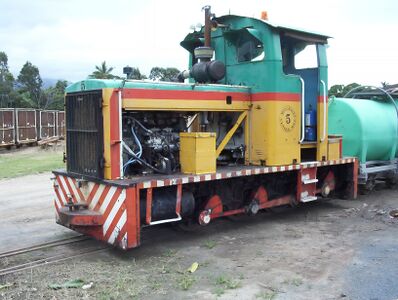 5 (ComEng. AA. A1005 of 1955).
 -
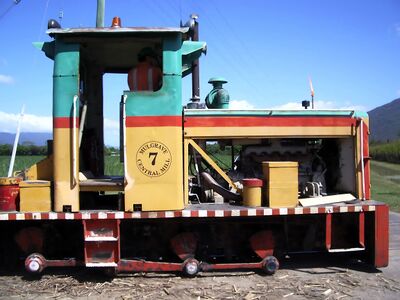 7 (ComEng. AA. B1010 of 1956).
 -
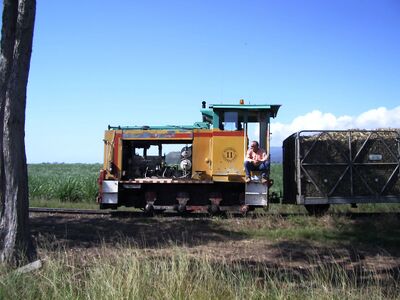 11 (E.M. Baldwin. DH18 Mk2. 4413-2-8-72 of 1972).
 -
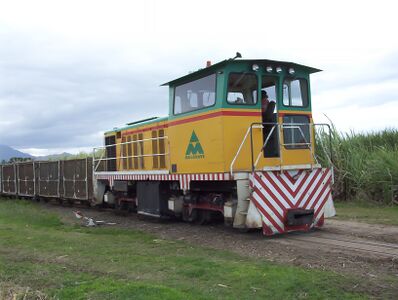 Mulgrave (Walkers. GH500. 613 of 1969).
 -
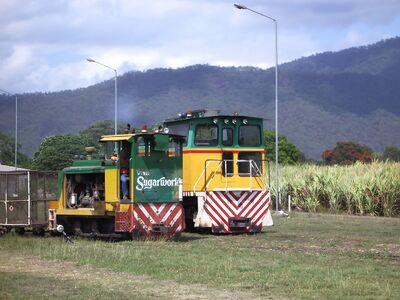 14 (Clyde. DHI-71. 56-86 of 1956).


These images are courtesy of William Thomson


References
- ↑ 1.0 1.1 Queensland Department of Agriculture and Stock. Queensland Agricultural Journal, 1 May 1931, p. 287.
- ↑ Cairns Regional Council. Cairns Thematic History.
- ↑ Queensland Commissioner for Railways. Report for the Year Ended 30 June 1912.
- ↑ Queensland Parliament. Legislative Assembly Hansard, 31 October 1991.
- ↑ 5.0 5.1 5.2 5.3 5.4 Queensland Sugar Corporation. Annual Report, Appendix A: Cane Crushed.
- ↑ The Maryborough Sugar Factory Limited. Annual Report 2008.
- ↑ The Maryborough Sugar Factory Limited. 2011 Results Presentation.
- ↑ MSF Sugar. 2011 Half Year Results and CEO Address.
- ↑ ABC News. MSF Sugar takeover complete in far north Qld. 23 February 2012.
- ↑ 10.0 10.1 CANEGROWERS, Annual Report 2024–25, table of Australian cane and sugar production.
- ↑ 11.0 11.1 Queensland Cane Agriculture and Renewables. Crush Statistics and Production Figures, December 2024.
- ↑ CANEGROWERS. 1993 Season Statistics.
- ↑ 13.0 13.1 13.2 Far North Queensland Sugar Industry Task Force. Statistical Picture of the Far North Queensland Sugar Industry in 1999.
- ↑ Mulgrave Central Mill Company. Annual Report, January 2001–June 2002.
- ↑ BSES Limited. Post-cyclone crop assessment, Appendix 4: Mulgrave Mill area.
- ↑ Australian Cane Farmers Association. Northern region report, December 2014.
- ↑ 17.0 17.1 CANEGROWERS. Annual Report 2016–17.
- ↑ MSF Sugar. Crushing Season a Success Despite Reduced Tonnages. December 2017.
- ↑ Sugar Research Australia. Harvesting Details — 2018 Season.
- ↑ 20.0 20.1 CANEGROWERS. Annual Report 2019–20.
- ↑ CANEGROWERS. Annual Report 2020–21.
- ↑ CANEGROWERS. Annual Report 2021–22.
- ↑ CANEGROWERS. Annual Report 2022–23.
- ↑ CANEGROWERS. Annual Report 2023–24, production table and Innisfail district report.
- ↑ Light Railway Research Society of Australia. Australian Sugar Industry Locomotives – Mulgrave Mill roster.
- ↑ Light Railway Research Society of Australia. Light Railway News, No. 108, October 1995.