
Lucinda Bulk Sugar Terminal: Difference between revisions
No edit summary |
|||
| Line 2: | Line 2: | ||
| name = Lucinda Bulk Sugar Terminal | | name = Lucinda Bulk Sugar Terminal | ||
| image = DJI 0061.jpg | | image = DJI 0061.jpg | ||
| caption = Lucinda Bulk Sugar Terminal. | | caption = Lucinda Bulk Sugar Terminal, 2025. | ||
| coordinates = | | coordinates = 18.52518° S, 146.33090° E | ||
| region = [[Herbert & Burdekin Region]] | | region = [[Herbert & Burdekin Region]] | ||
| lga = [[Hinchinbrook Shire Council]] | | lga = [[Hinchinbrook Shire Council]] | ||
| established = 1958 ({{#expr:{{CURRENTYEAR}}-1958}} years ago) | | established = 1958 ({{#expr:{{CURRENTYEAR}}-1958}} years ago) | ||
| closed = | | closed = | ||
| owner = [[Sugar Terminals Limited]] | | owner = [[Sugar Terminals Limited]] | ||
| gauge = 610 mm (2 ft) | | gauge = 610 mm (2 ft) | ||
| crush = | | crush = 235,000 tonnes storage capacity | ||
}} | }} | ||
'''Lucinda Bulk Sugar Terminal''' is a | '''Lucinda Bulk Sugar Terminal''' is a bulk raw sugar storage and export facility located at [[Lucinda, Queensland|Lucinda]], approximately 110 kilometres north of [[Townsville]]. Opened in 1958, it serves the [[Herbert River]] sugar district and receives raw sugar from [[Victoria Mill]] and [[Macknade Mill]] by 610 mm (2 ft) gauge railway. | ||
The terminal is owned and operated by [[Sugar Terminals Limited]] (STL). It contains three bulk sugar storage sheds with a current published capacity of approximately 235,000 tonnes. | |||
Lucinda is particularly notable for its 5.76-kilometre offshore conveyor jetty, one of the longest structures of its type in the world. The jetty carries raw sugar from the onshore terminal to a deep-water berth and shiploader in the Coral Sea. | |||
== History == | == History == | ||
A bulk terminal was | === Early sugar port === | ||
The Herbert River sugar industry used coastal and river transport extensively during the late nineteenth century. | |||
Before the development of Lucinda Point, raw sugar from mills including Victoria and Macknade was transported from local wharves in punts or lighters to Dungeness for transfer to larger vessels. | |||
Increasing silting in the Herbert River encouraged the development of a more reliable outlet. In 1896, CSR extended its 610 mm gauge tramway from Halifax to Lucinda Point, constructed a jetty and transferred its sugar storage shed from Halifax to the new port. | |||
From that time, bagged raw sugar from Victoria and Macknade was transported by rail directly to Lucinda Point. The sugar was carried on flat-top bogie wagons and loaded onto ships at the jetty. | |||
=== Bulk terminal === | |||
Queensland's sugar industry began changing from bagged to bulk raw sugar handling during the 1950s. | |||
A completely new bulk sugar terminal was constructed at Lucinda Point and commenced operation in '''1958'''. Raw sugar was thereafter transported from the mills in purpose-built bulk sugar boxes rather than jute bags. | |||
Lucinda was one of the first Queensland ports converted to bulk sugar handling, following Mackay in 1957 and opening in the same year as the Bundaberg terminal. | |||
The terminal initially also handled raw sugar from [[Tully Mill]]. Tully sugar, which had previously been transported to Townsville, was directed to Lucinda after the terminal opened in 1958. From 1961, Tully raw sugar was instead transported by road to [[Mourilyan Bulk Sugar Terminal]]. | |||
A second storage shed was constructed at Lucinda in '''1965'''. | |||
Despite the introduction of bulk handling, Lucinda remained restricted by shallow water and bends in the Hinchinbrook Channel. Ships using the original facility generally carried comparatively small cargoes, and the changing economics of international bulk shipping increasingly favoured much larger vessels. | |||
=== Deep-water development === | |||
By the 1970s the limitations of the original port had become increasingly significant. | |||
In 1974 the Queensland Sugar Board commissioned Macdonald Wagner & Priddle, working in association with CSR, to examine alternatives for the future of Lucinda. | |||
The principal options considered were: | |||
* closing Lucinda and transporting Herbert River sugar to Townsville; | |||
* undertaking continuing dredging to allow larger ships to use the existing berth; or | |||
* constructing a new offshore berth in naturally deep water, connected to the shore by a long conveyor jetty. | |||
The offshore option was selected. | |||
In November 1975 the Bulk Sugar Consultative Committee formally supported development of an offshore loading facility together with increased storage capacity. | |||
Construction took place between 1976 and 1979. The project was financed by the Queensland sugar industry, with the Sugar Board and Department of Harbours and Marine involved in its development. CSR acted as project manager, Macdonald Wagner & Priddle as consulting engineers and Transfield (Queensland) as head contractor. | |||
The project included: | |||
* a third bulk sugar storage shed with a capacity of approximately 79,000 tonnes; | |||
* a 5.76-kilometre conveyor jetty extending from Lucinda Point to naturally deep water; | |||
* an offshore wharf and shiploader capable of handling substantially larger export vessels. | |||
The deep-water berth and associated facilities were officially opened by Prime Minister Malcolm Fraser on '''2 July 1979'''. | |||
The development transformed Lucinda from a terminal limited largely to smaller coastal ships into a major overseas export port. | |||
== | == Ownership and operation == | ||
The original bulk terminals were developed within Queensland's regulated sugar industry and were held through government and port authority arrangements. | |||
During industry restructuring in the late 1990s, [[Sugar Terminals Limited]] was established as an industry-owned company. Ownership of Queensland's bulk sugar terminal assets, including Lucinda, was transferred to STL in August 2000. | |||
For many years Queensland Sugar Limited operated the terminals on behalf of STL. | |||
From '''1 July 2026''', STL brought terminal operations in-house and became both owner and operator of the Lucinda Bulk Sugar Terminal. | |||
The marine port itself is administered by the Port of Townsville Limited. | |||
== Cyclone Yasi == | |||
Severe Tropical Cyclone Yasi crossed the North Queensland coast near Mission Beach during the early hours of 3 February 2011, with the centre of the cyclone passing approximately 40 kilometres north of Lucinda. | |||
The offshore jetty, wharf, conveyors, electrical equipment and shiploading infrastructure sustained extensive damage from extreme waves and storm surge. | |||
Damage to the terminal was subsequently valued at approximately '''$50 million'''. | |||
Repair work included replacement or repair of approximately one kilometre of steel structures and cladding, major electrical reconstruction, repairs to the wharf and shiploader, replacement of damaged concrete and structural components, and strengthening intended to improve resilience to future cyclones. | |||
Abergeldie was the principal construction contractor and Aurecon provided engineering, design, supervision and commissioning services. | |||
While Lucinda was unavailable, approximately 400,000 tonnes of Herbert River raw sugar was transported south to Townsville for shipment. | |||
The first vessel to use the restored terminal was the ''New Ambition'', which began loading approximately 27,000 tonnes of raw sugar on '''27 August 2012'''. The terminal was formally reopened on 1 November 2012. | |||
== Infrastructure == | == Infrastructure == | ||
=== Storage === | |||
Lucinda Bulk Sugar Terminal contains '''three bulk sugar storage sheds'''. | |||
Sugar Terminals Limited currently publishes a combined storage capacity of approximately '''235,000 tonnes'''. Earlier industry publications commonly gave the capacity as approximately 231,000 tonnes. | |||
The third shed, constructed as part of the 1976–1979 deep-water development, added approximately 79,000 tonnes of storage. | |||
=== Rail receival === | |||
Unlike most Queensland bulk sugar terminals, Lucinda continues to receive raw sugar by narrow-gauge railway. | |||
Raw sugar from [[Victoria Mill]] and [[Macknade Mill]] is transported in purpose-built bogie sugar boxes over the Herbert River district's 610 mm (2 ft) gauge railway. | |||
The routes from the two mills converge east of Cordelia before continuing through the Halifax district and across the coastal mangrove flats to Lucinda. | |||
Mill locomotives deliver loaded sugar boxes to the terminal railway yard. The terminal's own shunting locomotive then moves the wagons through the unloading facility. | |||
Lucinda is one of the few surviving examples in Australia of raw sugar being transported directly from sugar mills to an export terminal by 610 mm gauge railway. | |||
=== Deep-water jetty === | |||
The offshore jetty extends '''5.76 kilometres''' from Lucinda Point to the deep-water loading berth. | |||
It is supported by more than 660 concrete and steel piles or pylons and carries an enclosed conveyor together with access and service infrastructure. | |||
The structure follows the curvature of the Earth. The Port of Townsville currently describes the jetty as dipping approximately '''1.2 metres''' over its length. | |||
Raw sugar takes approximately '''22 minutes''' to travel by conveyor from the onshore storage sheds to the offshore shiploader. | |||
The original 1979 installation was designed to load at approximately 1,400 tonnes per hour. Following subsequent improvements and the Cyclone Yasi reconstruction, STL reported loading capability exceeding 1,800 tonnes per hour. | |||
=== Shipping === | |||
Current Sugar Terminals Limited shipping limits for Lucinda are: | |||
{| class="wikitable" | {| class="wikitable" | ||
! Statistic | ! Statistic | ||
! Value | ! Value | ||
|- | |- | ||
| Storage | | Storage capacity | ||
| | | 235,000 tonnes | ||
|- | |- | ||
| | | Number of sheds | ||
| | | 3 | ||
|- | |- | ||
| Jetty | | Receival method | ||
| 610 mm light rail | |||
|- | |||
| Jetty length | |||
| 5.76 kilometres | | 5.76 kilometres | ||
|- | |- | ||
| | | Maximum vessel length (LOA) | ||
| | | 225 metres | ||
|- | |||
| Maximum beam | |||
| 32.5 metres | |||
|- | |||
| Berth depth at LAT | |||
| 13.60 metres | |||
|- | |||
| Channel depth at LAT | |||
| 13.20 metres | |||
|} | |} | ||
| Line 65: | Line 162: | ||
== Rollingstock == | == Rollingstock == | ||
Lucinda Bulk Sugar Terminal maintains its own 610 mm gauge shunting locomotive for movement of sugar boxes between the receival yard and unloading facilities. | |||
{{#get_db_data: | {{#get_db_data: | ||
| Line 98: | Line 196: | ||
== Image Gallery == | == Image Gallery == | ||
<gallery mode="packed" heights="200"> | <gallery mode="packed" heights="200"> | ||
File:EricMPlomley-PreResto.png|Eric | File:EricMPlomley-PreResto.png|Eric M. Plomley (ComEng AD, G1023 of 1958), before rebuilding, crossing the road into the bulk sugar terminal yard. October 2014. | ||
File:EricMPlomley.jpg|Eric | File:EricMPlomley.jpg|Eric M. Plomley (ComEng AD, G1023 of 1958), after rebuilding, in the terminal yard. September 2020. | ||
</gallery> | </gallery> | ||
== References == | == References == | ||
<references /> | <references /> | ||
Latest revision as of 11:46, 5 October 2026
| Lucinda Bulk Sugar Terminal | |
|---|---|
|
| |
| Location | |
| Coordinates | 18.52518° S, 146.33090° E |
| State | Queensland |
| Region | Herbert & Burdekin Region |
| LGA | Hinchinbrook Shire Council |
| Details | |
| Established | 1958 (68 years ago) |
| Owner | Sugar Terminals Limited |
| Gauge | 610 mm (2 ft) |
| Annual Crush | 235,000 tonnes storage capacity |

Lucinda Bulk Sugar Terminal is a bulk raw sugar storage and export facility located at Lucinda, approximately 110 kilometres north of Townsville. Opened in 1958, it serves the Herbert River sugar district and receives raw sugar from Victoria Mill and Macknade Mill by 610 mm (2 ft) gauge railway.
The terminal is owned and operated by Sugar Terminals Limited (STL). It contains three bulk sugar storage sheds with a current published capacity of approximately 235,000 tonnes.
Lucinda is particularly notable for its 5.76-kilometre offshore conveyor jetty, one of the longest structures of its type in the world. The jetty carries raw sugar from the onshore terminal to a deep-water berth and shiploader in the Coral Sea.
History
Early sugar port
The Herbert River sugar industry used coastal and river transport extensively during the late nineteenth century.
Before the development of Lucinda Point, raw sugar from mills including Victoria and Macknade was transported from local wharves in punts or lighters to Dungeness for transfer to larger vessels.
Increasing silting in the Herbert River encouraged the development of a more reliable outlet. In 1896, CSR extended its 610 mm gauge tramway from Halifax to Lucinda Point, constructed a jetty and transferred its sugar storage shed from Halifax to the new port.
From that time, bagged raw sugar from Victoria and Macknade was transported by rail directly to Lucinda Point. The sugar was carried on flat-top bogie wagons and loaded onto ships at the jetty.
Bulk terminal
Queensland's sugar industry began changing from bagged to bulk raw sugar handling during the 1950s.
A completely new bulk sugar terminal was constructed at Lucinda Point and commenced operation in 1958. Raw sugar was thereafter transported from the mills in purpose-built bulk sugar boxes rather than jute bags.
Lucinda was one of the first Queensland ports converted to bulk sugar handling, following Mackay in 1957 and opening in the same year as the Bundaberg terminal.
The terminal initially also handled raw sugar from Tully Mill. Tully sugar, which had previously been transported to Townsville, was directed to Lucinda after the terminal opened in 1958. From 1961, Tully raw sugar was instead transported by road to Mourilyan Bulk Sugar Terminal.
A second storage shed was constructed at Lucinda in 1965.
Despite the introduction of bulk handling, Lucinda remained restricted by shallow water and bends in the Hinchinbrook Channel. Ships using the original facility generally carried comparatively small cargoes, and the changing economics of international bulk shipping increasingly favoured much larger vessels.
Deep-water development
By the 1970s the limitations of the original port had become increasingly significant.
In 1974 the Queensland Sugar Board commissioned Macdonald Wagner & Priddle, working in association with CSR, to examine alternatives for the future of Lucinda.
The principal options considered were:
- closing Lucinda and transporting Herbert River sugar to Townsville;
- undertaking continuing dredging to allow larger ships to use the existing berth; or
- constructing a new offshore berth in naturally deep water, connected to the shore by a long conveyor jetty.
The offshore option was selected.
In November 1975 the Bulk Sugar Consultative Committee formally supported development of an offshore loading facility together with increased storage capacity.
Construction took place between 1976 and 1979. The project was financed by the Queensland sugar industry, with the Sugar Board and Department of Harbours and Marine involved in its development. CSR acted as project manager, Macdonald Wagner & Priddle as consulting engineers and Transfield (Queensland) as head contractor.
The project included:
- a third bulk sugar storage shed with a capacity of approximately 79,000 tonnes;
- a 5.76-kilometre conveyor jetty extending from Lucinda Point to naturally deep water;
- an offshore wharf and shiploader capable of handling substantially larger export vessels.
The deep-water berth and associated facilities were officially opened by Prime Minister Malcolm Fraser on 2 July 1979.
The development transformed Lucinda from a terminal limited largely to smaller coastal ships into a major overseas export port.
Ownership and operation
The original bulk terminals were developed within Queensland's regulated sugar industry and were held through government and port authority arrangements.
During industry restructuring in the late 1990s, Sugar Terminals Limited was established as an industry-owned company. Ownership of Queensland's bulk sugar terminal assets, including Lucinda, was transferred to STL in August 2000.
For many years Queensland Sugar Limited operated the terminals on behalf of STL.
From 1 July 2026, STL brought terminal operations in-house and became both owner and operator of the Lucinda Bulk Sugar Terminal.
The marine port itself is administered by the Port of Townsville Limited.
Cyclone Yasi
Severe Tropical Cyclone Yasi crossed the North Queensland coast near Mission Beach during the early hours of 3 February 2011, with the centre of the cyclone passing approximately 40 kilometres north of Lucinda.
The offshore jetty, wharf, conveyors, electrical equipment and shiploading infrastructure sustained extensive damage from extreme waves and storm surge.
Damage to the terminal was subsequently valued at approximately $50 million.
Repair work included replacement or repair of approximately one kilometre of steel structures and cladding, major electrical reconstruction, repairs to the wharf and shiploader, replacement of damaged concrete and structural components, and strengthening intended to improve resilience to future cyclones.
Abergeldie was the principal construction contractor and Aurecon provided engineering, design, supervision and commissioning services.
While Lucinda was unavailable, approximately 400,000 tonnes of Herbert River raw sugar was transported south to Townsville for shipment.
The first vessel to use the restored terminal was the New Ambition, which began loading approximately 27,000 tonnes of raw sugar on 27 August 2012. The terminal was formally reopened on 1 November 2012.
Infrastructure
Storage
Lucinda Bulk Sugar Terminal contains three bulk sugar storage sheds.
Sugar Terminals Limited currently publishes a combined storage capacity of approximately 235,000 tonnes. Earlier industry publications commonly gave the capacity as approximately 231,000 tonnes.
The third shed, constructed as part of the 1976–1979 deep-water development, added approximately 79,000 tonnes of storage.
Rail receival
Unlike most Queensland bulk sugar terminals, Lucinda continues to receive raw sugar by narrow-gauge railway.
Raw sugar from Victoria Mill and Macknade Mill is transported in purpose-built bogie sugar boxes over the Herbert River district's 610 mm (2 ft) gauge railway.
The routes from the two mills converge east of Cordelia before continuing through the Halifax district and across the coastal mangrove flats to Lucinda.
Mill locomotives deliver loaded sugar boxes to the terminal railway yard. The terminal's own shunting locomotive then moves the wagons through the unloading facility.
Lucinda is one of the few surviving examples in Australia of raw sugar being transported directly from sugar mills to an export terminal by 610 mm gauge railway.
Deep-water jetty
The offshore jetty extends 5.76 kilometres from Lucinda Point to the deep-water loading berth.
It is supported by more than 660 concrete and steel piles or pylons and carries an enclosed conveyor together with access and service infrastructure.
The structure follows the curvature of the Earth. The Port of Townsville currently describes the jetty as dipping approximately 1.2 metres over its length.
Raw sugar takes approximately 22 minutes to travel by conveyor from the onshore storage sheds to the offshore shiploader.
The original 1979 installation was designed to load at approximately 1,400 tonnes per hour. Following subsequent improvements and the Cyclone Yasi reconstruction, STL reported loading capability exceeding 1,800 tonnes per hour.
Shipping
Current Sugar Terminals Limited shipping limits for Lucinda are:
| Statistic | Value |
|---|---|
| Storage capacity | 235,000 tonnes |
| Number of sheds | 3 |
| Receival method | 610 mm light rail |
| Jetty length | 5.76 kilometres |
| Maximum vessel length (LOA) | 225 metres |
| Maximum beam | 32.5 metres |
| Berth depth at LAT | 13.60 metres |
| Channel depth at LAT | 13.20 metres |
Location
Rollingstock
Lucinda Bulk Sugar Terminal maintains its own 610 mm gauge shunting locomotive for movement of sugar boxes between the receival yard and unloading facilities.
| Name | Builder | Model | Serial | Year | Current Mill | Notes |
|---|---|---|---|---|---|---|
| Eric. M. Plomley | Commonwealth Engineering | AD | G1023 | 1958 | Lucinda Bulk Sugar Terminal | Rebuilt 2017 |
Image Gallery
-
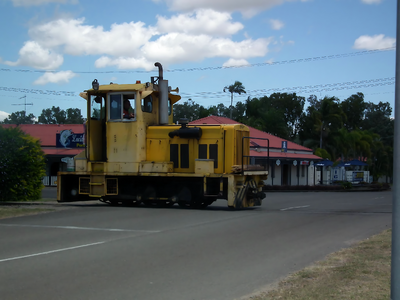 Eric M. Plomley (ComEng AD, G1023 of 1958), before rebuilding, crossing the road into the bulk sugar terminal yard. October 2014.
-
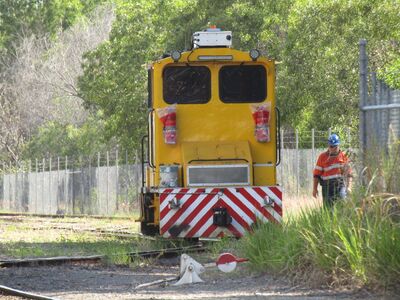 Eric M. Plomley (ComEng AD, G1023 of 1958), after rebuilding, in the terminal yard. September 2020.

