
Mossman Central Mill: Difference between revisions
No edit summary |
No edit summary |
||
| Line 1: | Line 1: | ||
== Mossman Central Mill == | == Mossman Central Mill == | ||
The '''Mossman Central Mill''', located in the Douglas Shire of Far North Queensland, was Australia's most northerly sugar mill until its closure in 2023. Operating for over 125 years, it was a pioneer in both rail transport and industrial automation within the Australian sugar industry. | The '''Mossman Central Mill''', located in the Douglas Shire of Far North Queensland, was Australia's most northerly sugar mill until its closure in 2023. Operating for over 125 years, it was a pioneer in both rail transport and industrial automation within the Australian sugar industry. | ||
Revision as of 13:29, 7 January 2026
Mossman Central Mill
The Mossman Central Mill, located in the Douglas Shire of Far North Queensland, was Australia's most northerly sugar mill until its closure in 2023. Operating for over 125 years, it was a pioneer in both rail transport and industrial automation within the Australian sugar industry.
History and Rail Infrastructure
Founded in 1894 under the Sugar Works Guarantee Act, the mill commenced its first crush on 23 August 1897. Because Mossman lacked a deep water port, the mill established a comprehensive 2 foot (610 mm) gauge tramway network. This network served a dual purpose: transporting raw sugar 12 kilometres to the Port Douglas wharf for shipping and providing a vital transport link for passengers and freight in the pre-motorised era.
By the mid 20th century, the tramway system had evolved from steam power to modern diesel-hydraulic locomotives. The mill gained international recognition in 1971 as the first sugar mill in the world to implement a process control computer to automate crushing operations, a move that set a global standard for the industry.
Ownership Transitions
The mill’s ownership history reflects the broader economic shifts in the Queensland sugar industry:
- 1897 to 2012: Operated as a grower-owned cooperative, the Mossman Central Mill Company Ltd.
- 2012 to 2019: Purchased by Mackay Sugar Limited for approximately 25 million dollars. This period saw the mill integrated into a larger corporate structure, though financial pressures eventually led Mackay Sugar to divest its northernmost asset.
- 2019 to 2024: Successfully bought back by local growers under the banner of Far Northern Milling Pty Ltd (FNM). This return to local control was intended to facilitate the transition of the site into the Daintree Bio Precinct, focusing on renewable energy and bio-products.
The Final Years and Liquidation
Despite the 2019 buy-back, the mill faced terminal challenges. A declining cane supply (often falling below the 500,000 tonne viability threshold) and the impacts of extreme weather events, including Cyclone Jasper in late 2023, placed the company under extreme financial duress.
- November 2023: FNM entered voluntary administration after the 2023 crush, which would ultimately be its last.
- March 2024: After a potential rescue deal with a private investor fell through, the mill was placed into formal liquidation.
- 2024 to 2025: For the first time in over a century, no cane was crushed at Mossman. Growers were forced to truck their 2024 and 2025 crops to the Mulgrave Mill in Gordonvale and South Johnstone Mill near Innisfail, supported by state government transport subsidies.
Asset Disposition and the Final Run
In December 2024, the liquidation reached a definitive stage with the auction of the mill's rolling stock and infrastructure via Grays Auction. The fleet of locomotives was purchased by MSF Sugar for use at their South Johnstone operations.
Notable locomotive movements in December 2024 included:
- Daintree: The fleet's flagship and largest locomotive was transported via a heavy haulage low-loader over the Rex Range via Mareeba to reach South Johnstone.
- Douglas and Faugh-a-Balugh/Faughy, Cook and Ivy: These locomotives were among the last seen leaving the township on trucks to Mourilyan. From there, Dogulas and Faugh-a-Balugh are now in Victoria with a private owner and Cook and Ivy remain in storage.
- Rolling Stock: Hundreds of cane bins were either sold to other mills or scrapped on-site throughout early 2025.
The 42 hectare mill site was listed for sale in late 2025, with the iconic 2 foot gauge tracks through Mill Street now largely silent and disconnected from the industry that built the town.
Location
Rollingstock
| Name | Builder | Model | Serial Number | Year | Notes |
|---|---|---|---|---|---|
| Pioneer | Fowler | 0-6-0T | 8047 | 1899 | Preserved - ANGRMS Woodford |
| Faugh-a-Balugh | Fowler | 0-6-0T | 8733 | 1900 | Plinthed - Port Douglas |
| Miallo | Fowler | 0-4-2T | 20276 | 1934 | Preserved - ANGRMS Woodford |
| Bundy | Bundaberg Fowler | 0-6-2T | 2 | 1952 | Preserved - Port Douglas |
| R.D. Rex | Perry | 0-4-2T | 7650.49.1 | 1949 | Preserved - ANGRMS Woodford |
| Ivy | Fowler | 0-4-2T | 15947 | 1922 | Operational - Mandalong Valley Tramway, NSW |
| Mossman | Commonwealth Engineering | AA | 1719 | 1957 | Preserved - ANGRMS Woodford |
| Cook | Commonwealth Engineering | AL | 3372 | 1964 | Mourilyan Storage Shed |
| Ivy | Commonwealth Engineering | AL | 4181 | 1965 | Mourilyan Storage Shed |
| Douglas | Commonwealth Engineering | AL | 2562 | 1963 | Private owner - Victoria |
| Faugh-a-Balugh | Commonwealth Engineering | AL | 4190 | 1965 | Private owner - Victoria |
| Daintree | E.M. Baldwin | DH28B | 7303-1-7-77 | 1977 | South Johnstone - Active |
| Habana | Clyde | DHI-71 | 60-215 | 1960 | Private owner - Mackay |
| Marian | Clyde | DHI-71 | 56-104 | 1956 | Unknown |
| Stumpy | Malcolm More | 4wDM | 1042 | 1942 | Preserved - Sydney |
| Cattle Creek | Commonwealth Engineering | AA | B1724 | 1957 | Unknown |
Images
-
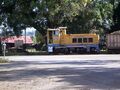 Daintree (E.M. Baldwin, DH28B, 1977) travelling entering the yard. 2005.
 -
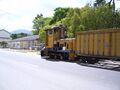 Mossman (Commonwealth Engineering, B1719, 1957) travelling outbound on Mill Street. 2005.

.jpg)
Sources:
- ↑ Australian Sugar Industry Locomotives - February 2000 Compiled by John Browning © John Browning 2000