
Lucinda Bulk Sugar Terminal: Difference between revisions
| (9 intermediate revisions by the same user not shown) | |||
| Line 4: | Line 4: | ||
| caption = Lucinda Bulk Sugar Terminal. 2025 | | caption = Lucinda Bulk Sugar Terminal. 2025 | ||
| coordinates = [https://www.google.com/maps?q=-18.525185684069758,146.33090836688496 18.52518° S, 146.33090° E] | | coordinates = [https://www.google.com/maps?q=-18.525185684069758,146.33090836688496 18.52518° S, 146.33090° E] | ||
| region = [[Herbert & Burdekin | | region = [[Herbert & Burdekin Region]] | ||
| lga = [[Hinchinbrook Shire Council]] | | lga = [[Hinchinbrook Shire Council]] | ||
| established = | | established = 1958 ({{#expr:{{CURRENTYEAR}}-1958}} years ago) | ||
| closed = | | closed = | ||
| owner = [[Sugar Terminals Limited | | owner = [[Sugar Terminals Limited]] | ||
| gauge = 610 mm (2 ft) | | gauge = 610 mm (2 ft) | ||
| crush = 467,000 tonnes raw sugar | | crush = 467,000 tonnes (storage capacity) | ||
}} | |||
'''Lucinda Bulk Sugar Terminal''' is a dedicated raw sugar export facility located at [[Lucinda, Queensland|Lucinda]], approximately 150 kilometres north of [[Townsville]]. It serves as the primary export gateway for the [[Herbert River]] sugar district, handling the entire output of the [[Victoria Mill]] and [[Macknade Mill]]. The facility is famous for its 5.76 kilometre long jetty, one of the longest of its kind in the world. | |||
== History == | |||
=== Establishment === | |||
The transition to a bulk loading facility at Lucinda was necessitated by the limitations of the previous system. Before 1958, raw sugar from the Herbert River mills was transported in sacks via tramway to Lucinda Point, where it was loaded onto lighters. These small vessels then carried the cargo to larger ships anchored in the deeper waters of the Hinchinbrook Channel.<ref name="Lighterage">Griggs, P. (2000). "Sugar Sacks and Lighters". Journal of Australian Studies.</ref> | |||
A bulk terminal was established in 1958 to replace the lightering system. However, the increasing size of international cargo vessels by the mid 1970s meant the existing berth could no longer accommodate modern shipping requirements. | |||
=== | === The Deepwater Jetty Project (1976–1979) === | ||
Between 1976 and 1979, the [[Colonial Sugar Refining Company]] (CSR) undertook a massive engineering project to construct a solution. The objective was to reach the deep water of the Coral Sea, bypassing the shallow coastal flats. This resulted in the construction of the 5.76 km jetty, which was officially opened by Prime Minister [[Malcolm Fraser]] in 1979.<ref name="WomensWeekly">The Australian Women's Weekly. "Where sugar is measured by the kilometre". 1979.</ref> | |||
=== Impact of Cyclone Yasi === | |||
In February 2011, Category 5 Cyclone Yasi made landfall near Mission Beach, placing Lucinda directly in the path of the storm's destructive southern eye wall. A massive storm surge and waves estimated at over 7 metres caused catastrophic damage to the offshore sections of the jetty. | |||
While the main pylons remained largely intact due to their robust design, the conveyor galleries, walkways, and the ship loader were either destroyed or severely compromised.<ref name="BOM_Yasi">Bureau of Meteorology. "Severe Tropical Cyclone Yasi". 2011.</ref> The reconstruction project was managed by engineering firm Aurecon, with repairs completed in time for the 2012 crushing season.<ref name="Aurecon">Aurecon. "Rebuild of Lucinda Bulk Sugar Terminal in wake of Cyclone Yasi". 2012.</ref> | |||
The | == Infrastructure == | ||
=== Jetty Engineering === | |||
The Lucinda jetty is a feat of precision engineering. Due to its extreme length, the design had to account for the curvature of the Earth. If a straight line were drawn from the base of the jetty at the shore, the end of the structure would be approximately 2 metres below that line due to the dip of the horizon.<ref name="Engineers">Engineering Heritage Australia. "Lucinda Bulk Sugar Terminal: Engineering Marker".</ref> | |||
Key technical features include: | |||
* '''Structure:''' The jetty consists of 108 spans supported by over 660 concrete and steel piles driven deep into the seabed. | |||
* '''Conveyor System:''' A single, continuous conveyor belt runs the entire length of the jetty. It travels at a speed of approximately 4.5 metres per second, taking about 22 minutes for raw sugar to travel from the storage sheds to the ship loader. | |||
=== Storage Capacity === | |||
Onshore, the terminal features three massive storage sheds providing a total storage capacity of roughly 467,000 tonnes.<ref name="STL_Lucinda">Sugar Terminals Limited. "Lucinda Bulk Sugar Terminal Fact Sheet". https://sugarterminals.com.au/locations/</ref> | |||
* '''Shed 1:''' 76,000 tonnes | |||
* '''Shed 2:''' 160,000 tonnes | |||
* '''Shed 3:''' 231,000 tonnes | |||
== | == Production Statistics == | ||
The terminal is the exclusive export point for the Herbert River district. | |||
{| class="wikitable" | |||
! Statistic | |||
! Value | |||
|- | |||
| Storage Capacity | |||
| 467,000 tonnes | |||
|- | |||
| Loading Rate | |||
| 1,400 tonnes per hour | |||
|- | |||
| Jetty Length | |||
| 5.76 kilometres | |||
|- | |||
| Receival Method | |||
| 610 mm Tramway | |||
|} | |||
== Location == | |||
<display_map>-18.52518, 146.33090</display_map> | |||
== Rollingstock == | == Rollingstock == | ||
| Line 48: | Line 72: | ||
|data=name=name,builder=builder,model=model,serial=serial_number,year=year,current_mill=current_mill,notes=notes | |data=name=name,builder=builder,model=model,serial=serial_number,year=year,current_mill=current_mill,notes=notes | ||
}} | }} | ||
<table class="wikitable sortable" style="width: 100%;"> | <table class="wikitable sortable" style="width: 100%;"> | ||
<tr> | <tr> | ||
| Line 70: | Line 95: | ||
}} | }} | ||
</table> | </table> | ||
== Image Gallery == | |||
<gallery mode="packed" heights="200"> | |||
File:EricMPlomley-PreResto.png|Eric. M. Plomley. (ComEng, AD, G1023) - pre-rebuild - crossing the road back into the bulk sugar terminal yards. October 2014. | |||
File:EricMPlomley.jpg|Eric. M. Plomley. (ComEng, AD, G1023) - post rebuild - sitting in the yard waiting for deliveries. September 2020. | |||
</gallery> | |||
== References == | |||
<references /> | |||
Latest revision as of 17:13, 15 January 2026
| Lucinda Bulk Sugar Terminal | |
|---|---|
|
| |
| Location | |
| Coordinates | 18.52518° S, 146.33090° E |
| State | Queensland |
| Region | Herbert & Burdekin Region |
| LGA | Hinchinbrook Shire Council |
| Details | |
| Established | 1958 (68 years ago) |
| Owner | Sugar Terminals Limited |
| Gauge | 610 mm (2 ft) |
| Annual Crush | 467,000 tonnes (storage capacity) |

Lucinda Bulk Sugar Terminal is a dedicated raw sugar export facility located at Lucinda, approximately 150 kilometres north of Townsville. It serves as the primary export gateway for the Herbert River sugar district, handling the entire output of the Victoria Mill and Macknade Mill. The facility is famous for its 5.76 kilometre long jetty, one of the longest of its kind in the world.
History
Establishment
The transition to a bulk loading facility at Lucinda was necessitated by the limitations of the previous system. Before 1958, raw sugar from the Herbert River mills was transported in sacks via tramway to Lucinda Point, where it was loaded onto lighters. These small vessels then carried the cargo to larger ships anchored in the deeper waters of the Hinchinbrook Channel.[1]
A bulk terminal was established in 1958 to replace the lightering system. However, the increasing size of international cargo vessels by the mid 1970s meant the existing berth could no longer accommodate modern shipping requirements.
The Deepwater Jetty Project (1976–1979)
Between 1976 and 1979, the Colonial Sugar Refining Company (CSR) undertook a massive engineering project to construct a solution. The objective was to reach the deep water of the Coral Sea, bypassing the shallow coastal flats. This resulted in the construction of the 5.76 km jetty, which was officially opened by Prime Minister Malcolm Fraser in 1979.[2]
Impact of Cyclone Yasi
In February 2011, Category 5 Cyclone Yasi made landfall near Mission Beach, placing Lucinda directly in the path of the storm's destructive southern eye wall. A massive storm surge and waves estimated at over 7 metres caused catastrophic damage to the offshore sections of the jetty.
While the main pylons remained largely intact due to their robust design, the conveyor galleries, walkways, and the ship loader were either destroyed or severely compromised.[3] The reconstruction project was managed by engineering firm Aurecon, with repairs completed in time for the 2012 crushing season.[4]
Infrastructure
Jetty Engineering
The Lucinda jetty is a feat of precision engineering. Due to its extreme length, the design had to account for the curvature of the Earth. If a straight line were drawn from the base of the jetty at the shore, the end of the structure would be approximately 2 metres below that line due to the dip of the horizon.[5]
Key technical features include:
- Structure: The jetty consists of 108 spans supported by over 660 concrete and steel piles driven deep into the seabed.
- Conveyor System: A single, continuous conveyor belt runs the entire length of the jetty. It travels at a speed of approximately 4.5 metres per second, taking about 22 minutes for raw sugar to travel from the storage sheds to the ship loader.
Storage Capacity
Onshore, the terminal features three massive storage sheds providing a total storage capacity of roughly 467,000 tonnes.[6]
- Shed 1: 76,000 tonnes
- Shed 2: 160,000 tonnes
- Shed 3: 231,000 tonnes
Production Statistics
The terminal is the exclusive export point for the Herbert River district.
| Statistic | Value |
|---|---|
| Storage Capacity | 467,000 tonnes |
| Loading Rate | 1,400 tonnes per hour |
| Jetty Length | 5.76 kilometres |
| Receival Method | 610 mm Tramway |
Location
Rollingstock
| Name | Builder | Model | Serial | Year | Current Mill | Notes |
|---|---|---|---|---|---|---|
| Eric. M. Plomley | Commonwealth Engineering | AD | G1023 | 1958 | Lucinda Bulk Sugar Terminal | Rebuilt 2017 |
Image Gallery
-
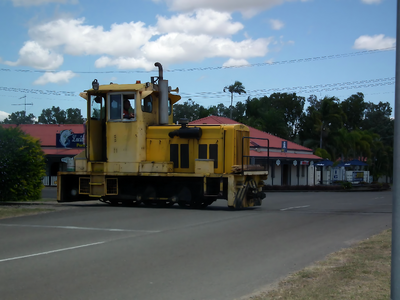 Eric. M. Plomley. (ComEng, AD, G1023) - pre-rebuild - crossing the road back into the bulk sugar terminal yards. October 2014.
 -
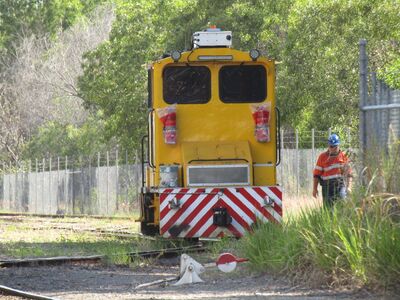 Eric. M. Plomley. (ComEng, AD, G1023) - post rebuild - sitting in the yard waiting for deliveries. September 2020.


References
- ↑ Griggs, P. (2000). "Sugar Sacks and Lighters". Journal of Australian Studies.
- ↑ The Australian Women's Weekly. "Where sugar is measured by the kilometre". 1979.
- ↑ Bureau of Meteorology. "Severe Tropical Cyclone Yasi". 2011.
- ↑ Aurecon. "Rebuild of Lucinda Bulk Sugar Terminal in wake of Cyclone Yasi". 2012.
- ↑ Engineering Heritage Australia. "Lucinda Bulk Sugar Terminal: Engineering Marker".
- ↑ Sugar Terminals Limited. "Lucinda Bulk Sugar Terminal Fact Sheet". https://sugarterminals.com.au/locations/